
STARS: Major | All | Constellations | Chinese | About
20♉20 to 16♎39
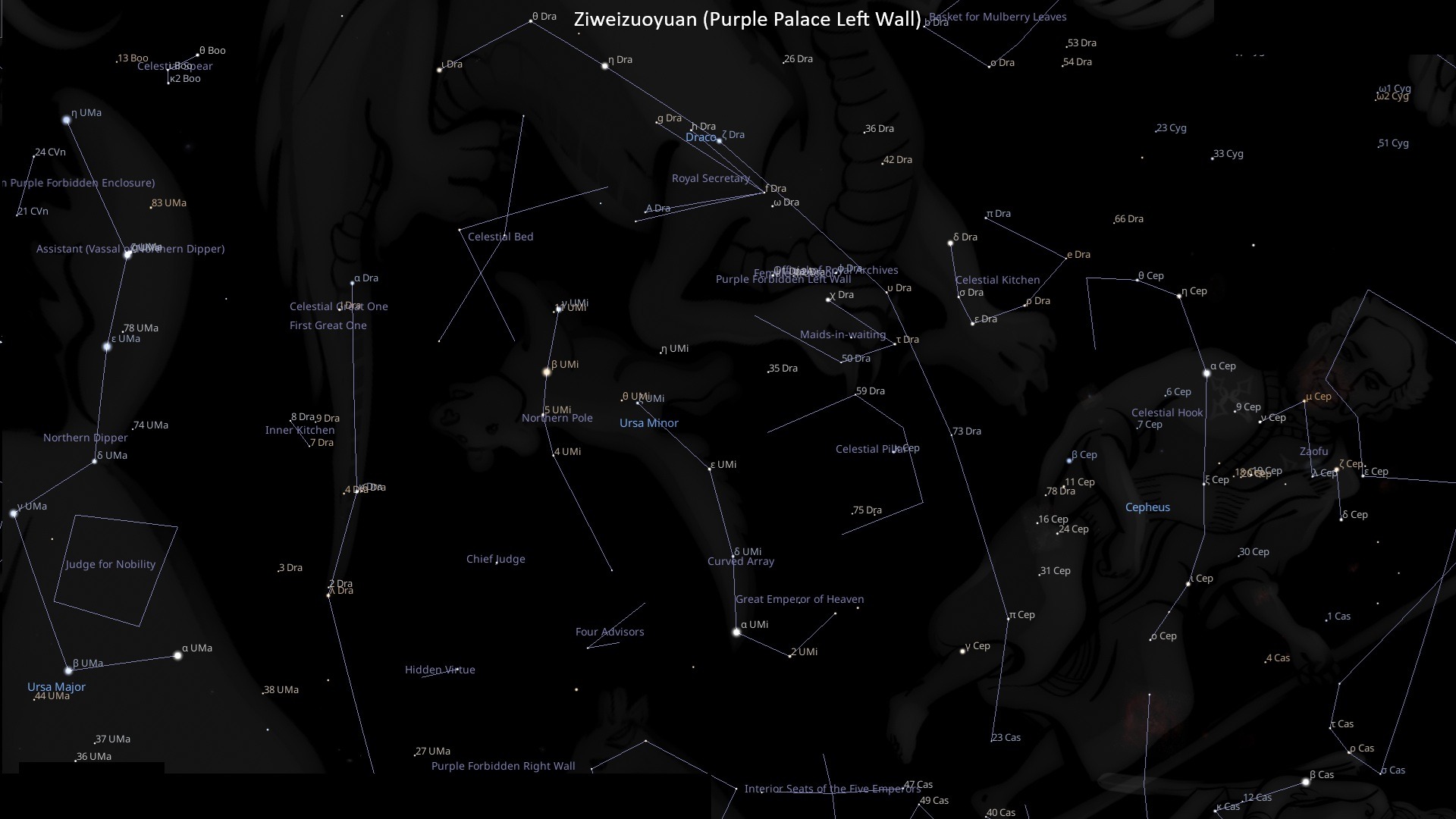
The 5th asterism of the Ziwei (Purple Palace) Enclosure is named 紫微左垣 Zǐwēizuǒyuán, “Purple Palace Left Wall.” It represents 8 guardian stars on the left, named after civil and military officials. It contains 8 stars in the constellations Draco, Cepheus and Cassiopeia. [1]
| 2000 | 2050 | IAU | Chinese | Orb |
| 04♎57 | 05♎40 | ι Dra | ZiweizuoyuanYi (1) | 1°50′ |
| 16♎39 | 17♎22 | θ Dra | Ziweizuoyuan Er (2) | 1°20′ |
| 14♎29 | 15♎13 | η Dra | Ziweizuoyuan San (3) | 2°00′ |
| 03♎23 | 04♎09 | ζ Dra | Ziweizuoyuan Si (4) | 1°50′ |
| 20♉20 | 21♉00 | υ Dra | Ziweizuoyuan Wu (5) | 1°00′ |
| 20♉55 | 21♉37 | 73 Dra | Ziweizuoyuan Liu (6) | 1°00′ |
| 23♉33 | 24♉15 | π Cep | Ziweizuoyuan Qi (7) | 1°10′ |
| 29♉29 | 00♊10 | 23 Cas | Ziweizuoyuan Ba (8) | 1°00′ |
Ziweizuoyuan the Purple Palace Left Wall
20♉20 to 16♎39
The Ziwei Left Enclosure, also known as the Left Wall of the Purple Palace, consists of 8 stars, named after civil and military officials. It was regarded as a “wall of heaven” symbolizing imperial authority in the ancient Chinese star system. The left and right walls of the Purple Palace together form the complete city walls, symbolizing a complete palace complex. From North to South:
- Zuoshu, ι Dra, Privy Councilor, in charge of important decision-making.
- Shangzai, θ Dra, Chief Minister, managing royal affairs inside and outside the palace, overseeing household administration.
- Shaozai, η Dra, Deputy Chief Minister, managing royal affairs inside and outside the palace, overseeing household administration.
- Shangbi, ζ Dra, Assistant Minister among the Three Dukes, assisting the emperor, harmonizing Yin and Yang.
- Shaobi, υ Dra, Assistant Minister among the Three Dukes (as above).
- Shangwei, 73 Dra, Palace Guard, in charge of the emperor’s safety and human correspondence, the position of “Weiwei” of the Nine Ministers.
- Shaowei, π Cep, Palace Guard (as above).
- Shaocheng, 23 Cas, Deputy Prime Minister, handled confidential documents and assisted in handling orders and human correspondence.
The naming logic of the 8 stars in the left wall reflects the three major principles of the official system in the Zhou Dynasty: the division of duties between the principal and the deputy, with “Shang” and “Shao” corresponding to the principal and deputy positions; the priority of royal affairs, with 6 of the 8 stars in charge of the affairs of the imperial family; and the hierarchical design of functions, from the decision-making end of the south gate to the execution end of the north gate. [2]
| IAU | Chinese Name | Meaning | Alternative |
| ι Dra | Zuoshu | Privy Councilor | Left Pivot |
| θ Dra | Shangzai | Chief Minister | Great Prime Minister |
| η Dra | Shaozai | Deputy Chief Minister | Second Prime Minister |
| ζ Dra | Shangbi | 1st Assistant Minister | Great Protector |
| υ Dra | Shaobi | 2nd Assistant Minister | Second Protector |
| 73 Dra | Shangwei | 1st Palace Guard | Great Imperial Guard |
| π Cep | Shaowei | 2nd Palace Guard | Second Imperial Guard |
| 23 Cas | Shaocheng | Deputy Prime Minister | Second Imperial Minister |
Ma Duanlin (1317)
The Ziwei Enclosure has fifteen stars, seven in the west (Right Wall) and eight in the east (Left Wall), located north of the Big Dipper. One is called Ziwei, the seat of the Great Emperor, the emperor’s constant residence, in charge of destiny and measure. Another is called Changyuan, Tianying, and Qixing, serving as vassal guards and protecting vassal states. When war breaks out in the palace, Qixing stands upright, indicating the emperor’s departure, personally leading the palace troops. Zhang Heng said that the Ziwei Enclosure has fifteen stars, eight in the east and seven in the west. The eastern vassal state is near the Changhe Gate. The first star is the Left Pivot, the second is the Supreme Minister, the third is the Junior Minister, the fourth is the Supreme Assistant, the fifth is the Junior Assistant, the sixth is the Supreme Guard, the seventh is the Junior Guard, and the eighth is the Junior Chancellor.
All these stars are auspicious when they are bright and clear; if they are exceptionally bright, it indicates the inner support system is flourishing. If the palace walls are straight and bright, the emperor will command troops; if they are open, war will break out. The western vassal state, open like a gate, is called the Changhe Gate. If a shooting star emerges from the gate and flies out into the fields, it indicates an imperial envoy carrying a message, which will be conveyed to the emperor based on the direction the star travels. The two Yin Virtue stars are located west of the Minister of the Palace within the Ziwei Palace. They govern the bestowal of virtue. Their divination is best if they are not bright; if they are bright, it indicates a new emperor has ascended the throne. The *Sui Shu* states: “The two stars west of the Shangshu (Minister of State) are Yin De and Yang De, who govern the relief and pacification in times of crisis.” They are further divided into two seated stars. The five stars southeast of the gate are Shangshu, who govern the advisors, consulting day and night; the dragon represents the advisors, this is the image. Zhang Heng said it represents the eight ministers, its interpretation is no different from the four assistants.” [3]
Song History (1346)
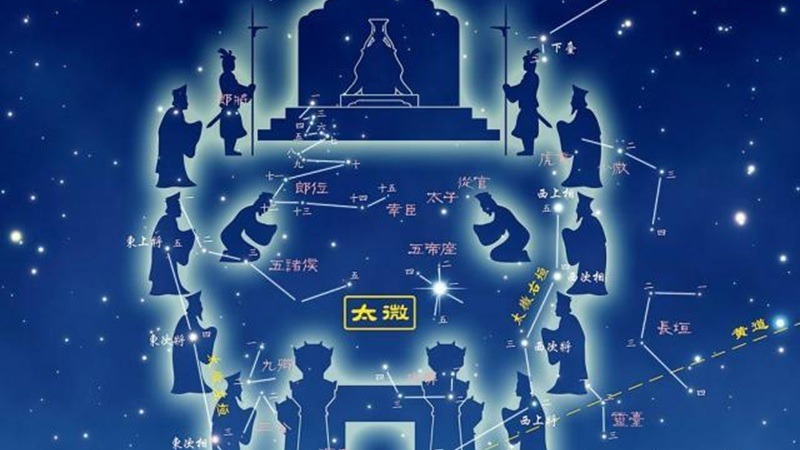
The Ziwei Enclosure (Purple Forbidden Enclosure) consists of an eastern wall of eight stars and a western wall of seven stars; situated north of the Big Dipper and arranged in flanking rows, they symbolize the guards protecting the sovereign. It is also known as the seat of the Great Emperor—the permanent abode of the Son of Heaven—and governs destiny and cosmic order.
In the eastern wall, the first star near the Changhe Gate is Zuoshu (Left Pivot); the second is Shangzai (Senior Chancellor); the third is Shaozai (Junior Chancellor); the fourth is Shangbi (Senior Assistant, also known as Shangfu); the fifth is Shaobi (Junior Assistant, also known as Shaofu); the sixth is Shangwei (Senior Guard); the seventh is Shaowei (Junior Guard); and the eighth is Shaocheng (Junior Aide, sometimes called Shangcheng).
Regarding divination: the stars should shine with uniform brightness and maintain constant size, signifying a flourishing inner administration; if the enclosure walls appear straight, the Son of Heaven will personally lead a military campaign; if a gate opens, warfare will erupt within the palace walls.
The opening directly south between the two walls is called Changhe. If a meteor (shooting star) emerges from this gate and travels across the countryside, it indicates an imperial envoy bearing a royal decree; the omen is interpreted based on the region the meteor moves toward. If a meteor enters or exits through any gate other than this one, it signifies an envoy from a foreign state.
If the Moon or Jupiter transgresses the Ziwei Enclosure, it foretells a royal bereavement.
If Venus or Mercury transgresses, it heralds a change of reign.
If Mars lingers within the enclosure, the ruler will lose his position.
If a guest star (nova) lingers there, it indicates insubordination or a change in the state’s government.
The appearance of the Guohuang star (large and yellowish-white, with sharp points above it) signifies warfare.
If a comet transgresses, an unusual king will be enthroned.
If a meteor (shooting star) transgresses, it signifies war, bereavement, and irregular weather (imbalances in floods and droughts).
If an envoy star (transient celestial phenomena like unexpected bright stars, comets, or meteors) enters the northern sector, warfare will break out. [4]
References
- Ziwei Enclosure – Baidu Encyclopedia
- Ziwei Left Wall – Baidu Encyclopedia.
- General Examination of Literature, Volume 278, Part 1, Ma Duanlin, 1317.
- Song History, Volume 49, Chapter 2, 1346.