
STARS: Major | All | Constellations | Chinese | About
20♍22 to 09♎40
The 27th Chinese lunar mansion is named 翼宿 Yì Su, “Wings Mansion.” It is the 6th of the 7 mansions of the Vermilion Bird of the South.
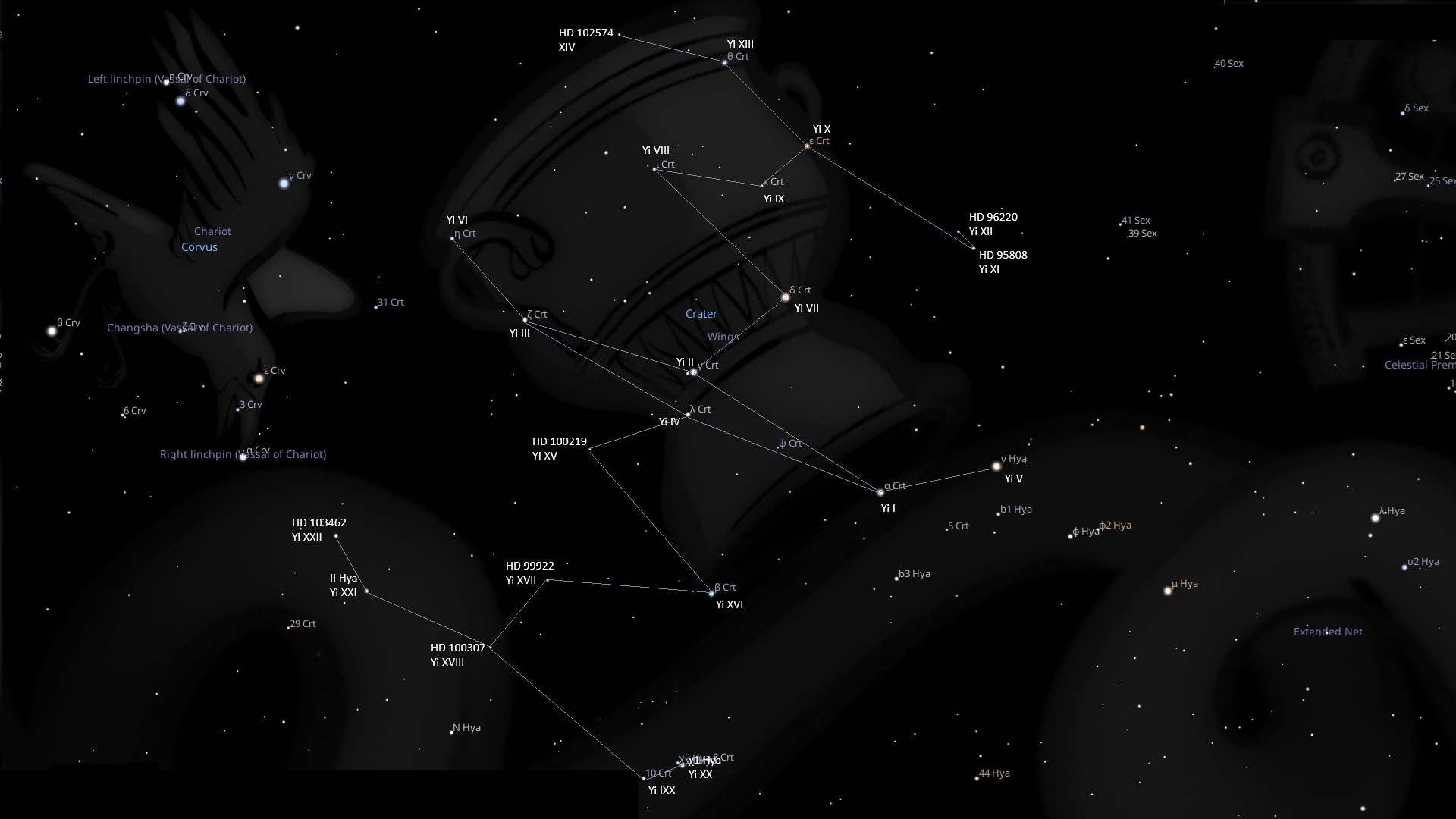
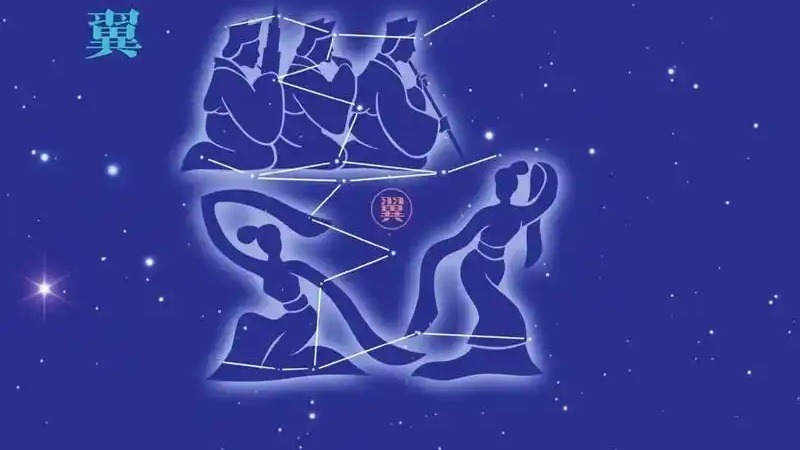
The 1st asterism of the Wings Mansion is also called 翼, “Wings.” It represents the wings of the Vermilion Bird and also represents the opera troupe and orchestra. It is composed of 22 stars of the constellations Crater and Hydra. [1]
| 2000 | 2050 | IAU | Chinese | Orb |
| 23♍41 | 24♍22 | α Crt | Yi Su Yi (1) | 1°20′ |
| 29♍14 | 29♍56 | γ Crt | Yi Su Er (2) | 1°20′ |
| 04♎04 | 04♎45 | ζ Crt | Yi Su San (3) | 1°00′ |
| 29♍22 | 00♎04 | λ Crt | Yi Su Si (4) | 1°00′ |
| 20♍22 | 21♍04 | ν Hya | Yi Su Wu (5) | 1°00′ |
| 06♎06 | 06♎48 | η Crt | Yi Su Liu (6) | 1°00′ |
| 26♍41 | 27♍23 | δ Crt | Yi Su Qi (7) | 1°40′ |
| 00♎28 | 01♎10 | ι Crt | Yi Su Ba (8) | 1°00′ |
| 27♍27 | 28♍09 | κ Crt | Yi Su Jiu (9) | 1°00′ |
| 26♍15 | 26♍56 | ε Crt | Yi Su Shi (10) | 1°00′ |
| 21♍28 | 22♍10 | HD 95808 | Yi Su Shiyi (11) | 1°00′ |
| 21♍56 | 22♍38 | HD 96220 | Yi Su Shier (12) | 1°00′ |
| 28♍35 | 29♍17 | θ Crt | Yi Su Shisan (13) | 1°00′ |
| 01♎29 | 02♎11 | HD 102574 | Yi Su Shisi (14) | 1°00′ |
| 02♎12 | 02♎54 | HD 100219 | Yi Su Shiwu (15) | 1°00′ |
| 28♍33 | 29♍15 | β Crt | Yi Su Shiliu (16) | 1°10′ |
| 03♎27 | 04♎09 | HD 99922 | Yi Su Shiqi (17) | 1°00′ |
| 05♎11 | 05♎53 | HD 100307 | Yi Su Shiba (18) | 1°00′ |
| 00♎31 | 01♎13 | 10 Crt | Yi Su Shijiu (19) | 1°00′ |
| 29♍19 | 00♎01 | χ¹ Hya | Yi Su Ershi (20) | 1°00′ |
| 08♎51 | 09♎33 | II Hya | Yi Su Ershiyi (21) | 1°00′ |
| 09♎40 | 10♎22 | HD 103462 | Yi Su Ershier (22) | 1°00′ |
II Hya also belongs to the ancient asterism Junmen (Military Gate) in the 28th lunar mansion Zhen (Chariot).
Constellation Yi the Wings
20♍22 to 09♎40
The twenty-two stars of the Wing (翼) constellation are shaped like outstretched wings of the Vermilion Bird and are associated with the fire element and the snake. It is called the “Music Bureau of Heaven,” in charge of court music, drama, sacrificial music and folk art. At the same time, Yi is also given a symbolic meaning of diplomacy and cultural exchange. Yi “hosts distant guests” and “brings barbarian guests,” symbolizing its conceptual role in ancient diplomacy, ethnic integration and cultural exchange.
In folk beliefs, the Winged Star God (also known as “Little Child Star” or “Old Man Star”) is worshipped by later generations of artists. His image is that of a white-faced child with a slight beard, and he is regarded as the patron god of opera, dance and other artists. [2]
Wing Astrology
The Wing Mansion is auspicious, ruled by the day, with wealth entering the house every year. All construction projects will be profitable, and descendants will be wealthy and own land. [1] It is suitable for building houses, walls, markets, cities, towns, and carts, and digging moats. Engaging in agriculture, commerce, planting, and marriage are all auspicious. [3]
Those born under the Wing constellation are strong, steady, self-assured, responsible, down-to-earth, hardworking and not ostentatious. They are gentle and romantic, desire harmony and pure love, like helping others and dislike competition and conflict.
The Wing gives talent in art, music, dance, literature and diplomacy. It is fortunate for travel and foreign countries. Suitable careers include performing arts, cultural dissemination, and international trade.
However, Wing people can be stubborn and inflexible in handling work, opinionated, sharp-tongued, critical and strict with others, which can cause hatred and trouble. Some may be poor throughout their lives, so they should practice self-improvement and do good deeds. As long as they work hard, they can achieve great success in any industry.
Wing people are generally healthy and look after themselves to prevent disease but may be prone to colds, throat, trachea and lung diseases. They should pay more attention to their liver and gallbladder, maintain a regular lifestyle, and avoid drinking alcohol.
Wing Men
Men of the Wing Constellation are gentle and humble, and speak steadily, but when faced with danger, they will lose confidence and abandon their original rigid attitude and principles. They are frank in their hearts, hope to receive help, do not gossip, do not speak pretentiously, are upright people, and their words and deeds are quite persuasive. They are kind by nature, do not like to compromise; therefore, they are inflexible and introverted.
Men of this constellation are very popular with women, but they are prone to romantic entanglements and being deceived by women they do not like. Their family life is not good, and they may remarry or find new love.
They can excel in politics, art, running a flower shop, or technology and gain fame, but they are not suitable for engaging in highly profitable commercial transactions.
The Wing Man may not have a smooth time in their youth, but their career foundation and strength will stabilize in middle age, earning them respect and allowing them to become professionals and authorities. People born under the Wing constellation can achieve success by developing abroad.
Wing Women
Women of the Wing constellation are patient, studious, diligent, have strong personal opinions, and are stubborn. They are capable at work, but they are content with their families after marriage and tend to marry late. They tend to hide their feelings deeply and are unwilling to speak their inner thoughts, so they may lack the charm of women in some aspects.
Women of this constellation are serious about love but often find happiness by marrying late. Some of them remarry and find happiness.
They can excel as writers, calligraphers, cooks, food experts, performers, and mass media workers. Their income is stable and abundant, but because of their heavy burden and large expenses, they struggle to accumulate wealth and will not accept support from others. They can achieve abundant wealth and status through their own efforts.
Some women may have small achievements in their youth, reaching their peak in middle age, and may become virtuous housewives after marriage. They have strong “overseas luck” and are likely to become authorities when developing in foreign lands. [1]
Winged Fire Serpent Advice
When you are lucky in the Wing constellation, you often leave home to pursue your dreams that are hard to achieve. However, you may also leave behind important people around you. The situation at home may not be so good. Sometimes, you may need to consider settling everything around you first before embarking on your journey to your dreams. Would that make things easier for you?
Some Winged individuals, because they enjoy and yearn for a lavish lifestyle and a higher realm, spend exorbitant amounts of money buying luxurious items that are inconsistent with their current status. Those around them mistakenly believe they are extremely wealthy, but they themselves are forced to maintain this facade because they are placed on such a high pedestal. Such a situation is destructive and hinders the Winged individuals from realizing their dreams. They must control themselves and not let the pursuit of their dreams turn into short-sighted vanity.
Pay attention to accumulation. The biggest fear for those born under the Wing constellation is that, while they may have a wide range of activities and care for those around them, become extremely busy and gain fame, they fail to accumulate wealth. Instead, their overly assertive nature, while earning respect, creates distance between them and others, leaving them to endure hardship alone. Those born under the Wing constellation need to focus on accumulating wealth in their daily lives and learn to relax. When needing help from others, they shouldn’t push themselves too hard. Giving others the opportunity to contribute is also giving them the right to express love. [3]
Ma Duanlin (1317)
The twenty-two stars of Yi are too difficult to identify; five above and five below, arranged horizontally, with six in the center resembling Zhang. Where are the other six stars? They are connected in groups of three, attached to the side of Zhang; if you cannot distinguish their location, please look ahead and remember: five black stars below Yi; their name is Dong’ou.
The Wing (翼) is located at 19 degrees. Gan Shi (甘氏) states that it governs the Taiwei (太微) star, the Three Dukes (三公), and the transmission of knowledge and literature. If it loses its color, the people will flee. When the sun and moon eclipse, the five planets are in opposition, or the celestial bodies move, the transmission of knowledge and literature will cease, and literature will be destroyed. If it shifts, the Three Dukes will be abolished. When it is bright and large, the transmission of knowledge and literature will be complete.
The Sui Shu (隋志) states that the Wing is the Heavenly Music Bureau, governing actors, entertainers, and also barbarian guests and those from the sea. When it is bright and large, rites and music will flourish, and barbarian tribes will come as guests. If it moves, barbarian envoys will come; if they migrate, the emperor will raise an army. Some say that when it is bright, rites and music will flourish; when it is dark, governance and education will fail. A solar eclipse indicates ministers usurping power; a lunar eclipse indicates women’s sorrow. The intrusion of the five planets, comets, celestial bodies, and celestial bodies is extremely ominous. [4]
Song History (1346)
The twenty-two stars of Yi Su (the Wing constellation) are the celestial music bureau, governing entertainers and theatrical performances, as well as foreign barbarians and guests from afar.
A bright and large star signifies the flourishing of rites and music, and the arrival of guests from all four kingdoms; a wavering star indicates the arrival of barbarian envoys; a shifting star signifies that the emperor will raise an army.
A solar eclipse signifies a king’s breach of etiquette, the slander of loyal ministers, and drought. A halo signifies the dismissal of music officials; three halos above the eclipse indicate that the enemy desires peace.
A lunar eclipse also indicates that loyal ministers are falsely accused, flying insects die in large numbers, warfare occurs in the north, and the empress’s displeasure. Shi Shen said: “High-ranking ministers plot treachery.”
If the moon transgresses Yi Su, national distress arises with warfare in that region; a great general dies, and the empress’s displeasure.
If Mercury aggressively (moving towards the Sun) enters Yi Su, lower-ranking ministers rebel and are executed; if it remains here for prolonged periods, drought, famine, population displacement, and appearances of dragons or snakes occur. If it resides in the central part of this region, large-scale warfare erupts. When it appears in the west, ministers worry.
If Venus enters or transgresses Yi Su, warfare erupts; when exiting, entering, lingering, or remaining here for extended periods, there will be great winds and floods, and the ruler will be uneasy. If it lingers to the left side of this constellation, drought follows. When Venus strikes, encircles, or aggressively enters this area (moving towards the Sun), ministers seize control over royal decrees.
If Mars transgresses Yi Su, famine occurs among the people in that area; subordinates disobey orders, and border warfare erupts; whether it enters, exits, lingers or remains here, military conflicts result. If it stays over this position for a prolonged period, treacherous ministers will cause chaos.
If Jupiter transgresses the Yi Su constellation, the five grains are damaged by wind. If it remains here for a long time, royal treasures increase, generals and chancellors remain loyal, and literary arts are employed; if it retrogrades into this region, the ruler becomes fond of hunting.
If Saturn transgresses Yi Su, high-ranking ministers worry; if it remains here long-term, the ruler is wise, and his ministers virtuous, harvests are abundant, and good news awaits the empress. Whether exiting, entering, lingering or remaining in this region, warfare results. If moving backward, the empress loses power.
If a guest star enters or transgresses this region, war occurs in the country, and high-ranking ministers worry; another interpretation is that an envoy from a country near the sea will arrive; when it guards, war breaks out.
If a comet transgresses the Yi Su region, high-ranking ministers worry, and the country experiences war or mourning events. If a comet appears over Yi Su, it also indicates concern for high-ranking ministers and the loss of rites and music in that region; when exiting this area, there are plots occurring locally with warfare or mourning events below. The direction pointed by its芒 (radiant) indicates where surrendering people will come from.
If meteors transgress Yi Su, concern also arises for high-ranking ministers; when exiting this region, warfare occurs below it. If entering here, noble officials are imprisoned or detained. The Yi Si Zhan states: “When a meteor enters the sky, virtuous scholars from all over the world will come to pay homage, the southern barbarians will come to pay tribute, and the country will have virtuous ministers.”
If red cloud formations enter or exit this area, sudden warfare erupts; if yellow and moist in appearance, feudal lords come to pay tribute. Black clouds indicate national concern.
According to the Han Dynasty Yongyua Bronze Instrument, Yi Su spans nineteen degrees; according to the Tang Kaiyuan Measuring Device, it measures eighteen degrees. Previously recorded as ninety-seven degrees away from the North Celestial Pole. Jingyou era measurements recorded Yi Su at eighteen degrees, with the western second star of its central row located 104 degrees from the North Celestial Pole. [5]
References
- Yì Xiù – Baidu Encyclopedia.
- Twenty-Eight Mansions – Baidu Encyclopedia.
- Comprehensive Analysis | Unveiling the Personality of [Wing Constellation].
- General Examination of Literature, Volume 279, Part 2, Ma Duanlin, 1317.
- Song History, Volume 51, Chapter 4, 1346.