
STARS: Major | All | Constellations | Chinese | About
22♎47 to 28♎06
The 3rd Chinese lunar mansion is named 氐宿 Dī Su, “Root Mansion.”
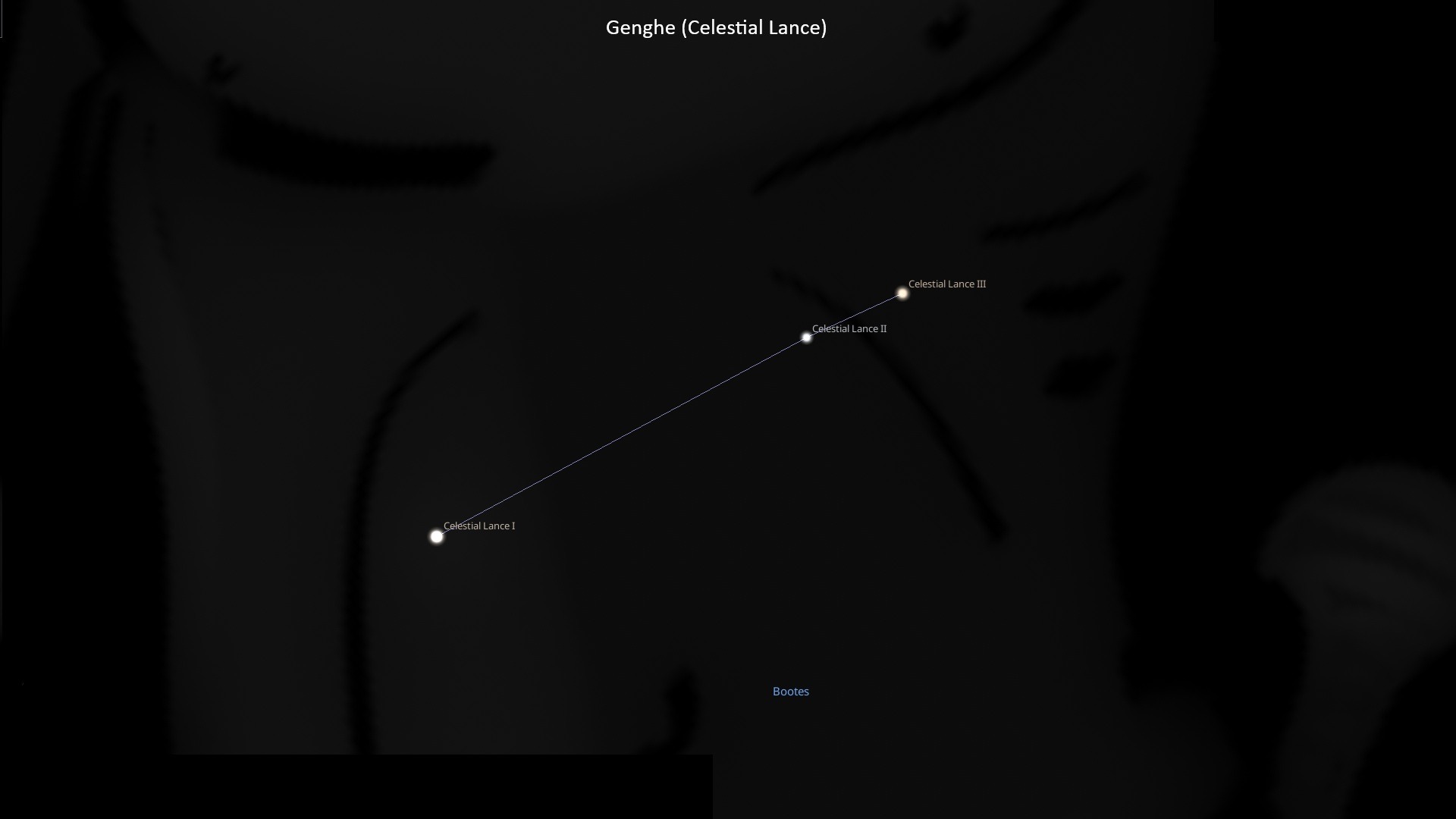
The 4th asterism of the Root Mansion is called 梗河 Gěnghé, “Celestial Lance,” representing a spear or shield. It consists of 3 stars in the constellation Boötes. [1]
| 2000 | 2050 | IAU | Chinese | Orb |
| 28♎06 | 28♎49 | ε Boo | Genghe Yi (1) | 2°10′ |
| 23♎54 | 24♎36 | σ Boo | Genghe Er (2) | 1°10′ |
| 22♎47 | 23♎29 | ρ Boo | Genghe San (3) | 1°40′ |
Genghe the Celestial Lance
22♎47 to 28♎06
Genghe (梗河), pronounced gěng hé, is an ancient Chinese constellation in Boötes, north of Arcturus.
Shi’s Classic of Stars, Vol. 1 (375 BC): “The three stars of the Geng River are located north of the Great Horn Emperor’s Seat (Arcturus), signifying the emperor’s power, as well as barbarian troops and loss. The saying goes: “Geng River represents clouds. Distance between them is auspicious; facing each other, war will break out.”
Book of Sui, Vol. 2 (636 AD): “The three stars of Genghe lie north of Dajiao (Arcturus). Genghe is the Celestial Spear. Also known as the Celestial Blade, it governs warfare against the Hu peoples and also portends mourning; thus, changes in its state correspond to military conflict or funeral events. If the stars vanish, it indicates that the state is facing a military plot.”
Book of Jin, Treatise on Astronomy I (648 AD): “The three stars known as Genghe constitute the Celestial Spear. Also called the Celestial Blade, they govern warfare against the Hu peoples and also portend mourning; thus, changes in their state correspond to military conflict or funeral events.” [2]
Ma Duanlin (1317)
The two stars of the Geng River, north of the Great Horn (Arcturus), are for the emperor to prepare for unforeseen events. Changes in their color indicate military losses. [3]
Song History (1346)
Geng He (River of Obstruction) consists of three stars north of Di Xi (Emperor’s Seat); it represents the Celestial Spear. Also known as Tian Feng (Celestial Blade), it governs military affairs on the northern border and matters of mourning; thus, changes in its appearance or position herald events related to warfare or death. The disappearance of a star indicates a plot for war within the state.
If a comet transgresses Genghe, northern forces will suffer defeat. The appearance of a guest star (unexpected star or nova) signals the departure of troops and disharmony between Yin and Yang; another interpretation is that the northern army invades China. A meteor (shooting star) appearing signifies war. Red clouds encroaching signify military defeat, while blue-white clouds indicate a general’s death. [4]
References
- Di Tuhao – Baidu Encyclopedia.
- Genghe – Baidu Encyclopedia.
- General Examination of Literature, Volume 279, Part 2, Ma Duanlin, 1317.
- Song History, Volume 50, Chapter 3, 1346.