
STARS: Major | All | Constellations | Chinese | About
15♏05 to 25♏08
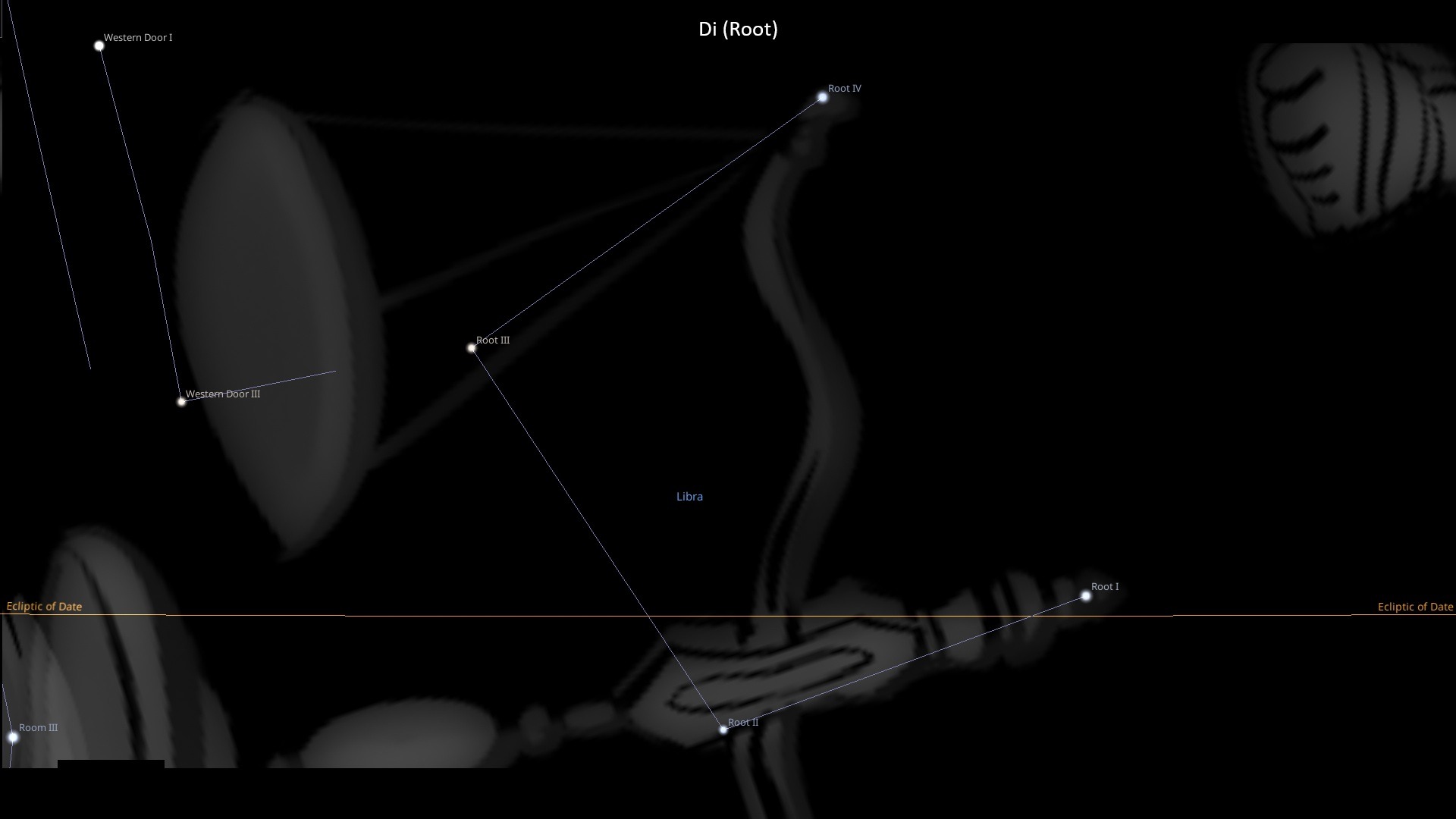
The 3rd Chinese lunar mansion is named 氐宿 Dī Su, “Root Mansion.”
The 1st asterism of the Root Mansion is also called 氐 Dī, “Root,” representing the Root in the sky; it means Azure Dragon’s chest and the front foot. It is composed of 4 stars in the constellation Libra. [1]
| 2000 | 2050 | IAU | Chinese | Orb |
| 15♏05 | 15♏47 | α² Lib | Di Su Yi (1) | 2°00′ |
| 22♏00 | 21♏42 | ι¹ Lib | Di Su Er (2) | 1°10′ |
| 25♏08 | 25♏50 | γ Lib | Di Su San (3) | 1°30′ |
| 19♏22 | 20♏04 | β Lib | Di Su Si (4) | 2°00′ |
Constellation Di the Root
15♏05 to 25♏08
Those born under the Root Constellation are understanding and easily gain help from others. They are skilled in strategy, resourceful, ambitious, decisive, yet refined and amiable. They often appear to wander because they dislike being bound by rules. [1]
Their inherent traits include amiability, understanding, strategic thinking, and easy access to support from elders. However, a rebellious nature can lead to setbacks in one’s fortune. A prosperous middle age requires planning for one’s later years. [2]
Those born under this constellation are destined for a life of Dharma harmony, possessing auspicious features and making offerings to the Buddha and Heaven. They are intelligent, understanding, and virtuous. They receive the king’s favor and enjoy wealth, intelligence, and a comfortable life for their families.
The Di constellation is suitable for making agricultural tools, planting barley, wheat, rice, millet, etc., and planting various fruit trees. Large-scale undertakings are not advisable. Brewing wine and nectar, planting jujubes, planting trees, sugarcane, etc., are all auspicious. [3]
Di belongs to the Earth element and is associated with the raccoon dog. The character 氐 (Di) signifies root and foundation, like a tree that needs roots to support its trunk and grow deep underground. However, when these roots are exposed, it signifies the cold winter and the withering of vegetation. The Records of the Grand Historian states, “氐 is the third constellation in the east; 氐 means that all things arrive.” 氐 is the third constellation in the east, representing the chest of the Azure Dragon, signifying a clear understanding of all things. The dragon’s chest is its vital center, of utmost importance, and therefore generally auspicious. [1]
The Records of the Grand Historian states that “the Di means that all things arrive,” and it is regarded as the chest of a blue dragon, often signifying good fortune. The names of its star officials mostly relate to military affairs: Zhaoyao and Genghe represent weapons, while Zhenche and Qizhen Jiangjun relate to chariots and cavalry. [2]
Di Su Advice
Those born under the Di constellation should be mindful of their own planning when managing others. Avoid putting too much pressure on others, as this could prevent them from achieving their goals and instead make those around them feel used and manipulated.
The world is not entirely corrupt, and human nature is not so despicable. Even in times of disappointment, believe that you can succeed through your own efforts. Do not choose extreme, self-destructive paths out of discouragement. Compassion is an excellent way for those born under the Di constellation to bring good fortune.
This world has many beautiful things. If Di Su understands the principle that “not all good things have to belong to you” and learns to control your desires, you will be more likely to find happiness. [3]
Ma Duanlin (1317)
Di, sixteen degrees, two feet below, is the central path of the five planets, the sun and moon, the Emperor’s path and resting place. If it is bright, ministers and empresses will serve the Emperor faithfully; if it is not visible or has moved, ministers and generals will plot internal strife, and chaos will ensue. Solar and lunar eclipses signify internal strife. If Jupiter afflicts it, an empress will be established. If Mars afflicts it, a minister will usurp the throne. If Venus afflicts it, a general will be appointed. If Mercury afflicts it, officials will be worried. If a guest star afflicts it, weddings will be disorderly. If a comet afflicts it, a violent uprising will occur. A lunar halo signifies unease. Another interpretation is that Di represents the residence of the empress and concubines, the chambers of rest and recuperation. The two stars in front (α² Lib and β Lib) represent the Empress; the two stars behind (ι¹ Lib and γ Lib) represent concubines. There will be corvée (forced) labor; the Di people will act first. If the stars are bright and large, the people will be spared hardship. [4]
Song History (1346)
Di Su consists of four stars representing the Emperor’s palace chambers, the residence of empresses and consorts, and a place for rest and relaxation. The first two stars (α² Lib and β Lib) represent the official wife; the last two stars (ι¹ Lib and γ Lib) symbolize concubines. It is also known as Tian Gen, the “Root of Heaven,” and governs epidemics and plagues.
If the last two stars are large, ministers will follow proper conduct and the ruler is secure; if small, it indicates that ministers have lost influence. If they move or shift, forced labor and compulsory service will arise.
A solar eclipse in this region signifies that high ministers or chancellors are engaging in flattery and slander; alternatively, it may indicate resentment from the sovereign’s empress or consorts toward certain officials, causing concern among high-ranking ministers. A solar halo indicates a dominant female ruler; it portends national distress or troop mobilization.
A lunar eclipse in Di Su bodes ill for high ministers and the empress’s consorts, or signals rising grain prices. A lunar halo presages misfortune for generals and the spread of epidemics; during winter, it indicates floods and danger to the ruler, which can be resolved through a pardon or amnesty.
If the moon transgresses Di Su, palace guard commanders face punishment, or war or banditry threatens. If the moon transgresses the right star (α² Lib), floods are imminent, while occultation (total covering) implies a secret plot involving a general.
If Mercury transgresses Di Su, high-ranking officials suffer sudden distress; if it remains over the mansion for a long time, floods, droughts, or war occur. If it enters or lingers here, high-ranking individuals face imprisonment. If it passes over the left-hand star (γ Lib), the Emperor takes personal command of the army.
If Venus transgresses Di Su, guards or generals will be executed; if it enters this region, disease and epidemics occur. Alternatively, it heralds a general’s appointment. If it passes over the right-hand star (α² Lib), floods occur.
If Mars transgresses Di Su, ministers overstep their authority; alternatively, generals suffer concern or distress; if it lingers over Di Su for a long time, an amnesty will be issued.
If Jupiter transgresses Di Su, there will be a pardon or the appointment of an empress; if it remains over Di Su for a prolonged period, earthquakes and bountiful harvests occur. If it moves in retrograde motion during this time, it heralds warfare.
If Saturn transgresses Di Su, palace guards or military commanders will be executed; if it remains over this mansion for a prolonged period, an amnesty is issued. If its color appears yellow, the empress experiences good fortune, or the crown prince may be formally invested. If it stations in the mansion, war erupts across the land; if all stars appear bright and clear, pardon follows.
If a guest star transgresses Di Su, the price of oxen and horses rises; if it is yellowish-white, good news or amnesty follows. Alternatively, it may indicate border warfare or turmoil in the inner palace. If such a star remains for fifty days without departing, an assassin is at large.
If a comet transgresses Di Su, a general amnesty will follow, and grain prices will rise; if the star disappears or fades, a great epidemic occurs. If it enters this region, minor military conflict arises; alternatively, the ruler will face instability.
If a bōxīng (a hairy or hazy tailless comet) transgresses Di Su, grain prices become high; if it exits the region, an amnesty is issued; if it enters, minor military conflict occurs. Some say that its transgression indicates ministers challenging or usurping the ruler’s authority.
If a shooting star transgresses Di Su, officials of the Secret Archives (secret or imperial library) will face trouble; occurring in winter or summer, it heralds floods or droughts; according to the Yisi Zhan (645 AD), it signifies good news in the inner palace, though a reddish-black hue indicates unrest within the inner palace among consorts and empresses.
Regarding the entry of cloud formations: yellow signifies earthworks or construction; black portends floods; red signifies warfare; blue-green or white indicates epidemic disease; and pure white signifies sorrow in the inner palace. [5]
References
- Twenty-Eight Mansions – Baidu Encyclopedia.
- Di Tuhao – Baidu Encyclopedia.
- Comprehensive Analysis | Unveiling the Personality of the Di Constellation.
- General Examination of Literature, Volume 279, Part 2, Ma Duanlin, 1317.
- Song History, Volume 50, Chapter 3, 1346.