
STARS: Major | All | Constellations | Chinese | About
12♉52 to 06♊35
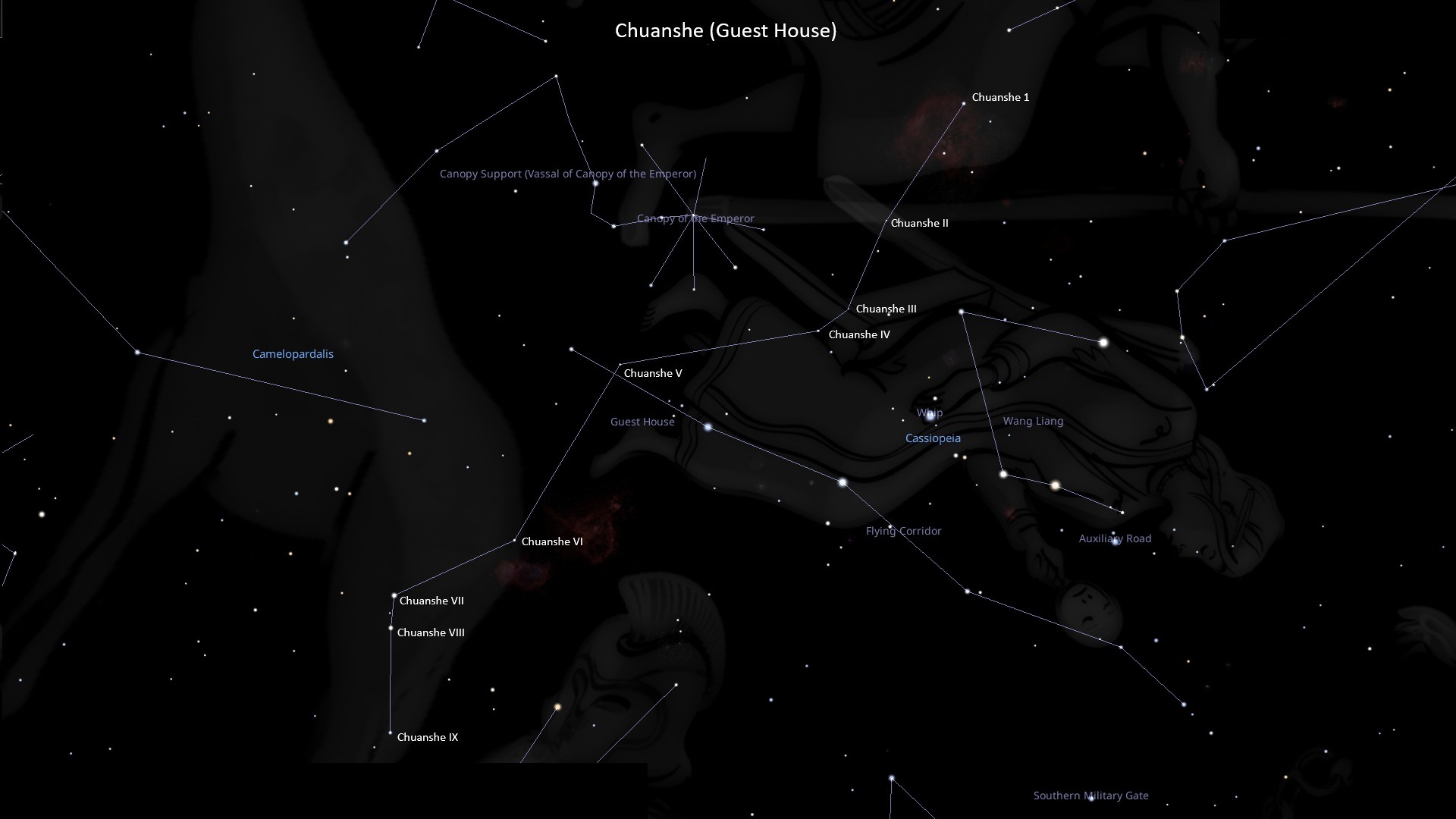
The 20th asterism of the Ziwei (Purple Forbidden) Enclosure is named 傳舍 Chuánshě, “Guest House.” It represents a place for guests to rest and stay in ancient times. It contains 9 stars in the constellations Camelopardalis, Cassiopeia and Cepheus. [1]
| 2000 | 2050 | IAU | Chinese | Orb |
| 12♉52 | 13♉34 | HD 223274 | Chuanshe Yi (1) | 1°00′ |
| 17♉05 | 17♉47 | 16 Cas | Chuanshe Er (2) | 1°00′ |
| 18♉40 | 19♉22 | HD 5775 | Chuanshe San (3) | 1°00′ |
| 20♉04 | 20♉46 | 32 Cas | Chuanshe Si (4) | 1°00′ |
| 29♉41 | 00♊23 | 55 Cas | Chuanshe Wu (5) | 1°00′ |
| 02♊19 | 03♊01 | HD 17948 | Chuanshe Liu (6) | 1°00′ |
| 06♊35 | 07♊17 | CS Cam | Chuanshe Qi (7) | 1°20′ |
| 06♊17 | 07♊00 | CE Cam | Chuanshe Ba (8) | 1°10′ |
| 05♊00 | 05♊43 | HD 21447 | Chuanshe Jiu (9) | 1°00′ |
Chuanshe the Guest House
12♉52 to 06♊35
The term “Chuanshe” first appeared during the Warring States period (475–221 BC). It referred to a place for officials, postmen, and nobles to rest, stay and change horses in ancient times.
King Min of Qi (323–284 BC) established three classes of guesthouses: the highest class was called “Dai She,” the middle class was called “Xing She,” and the lowest class was called “Chuan She.” Dai She was for those who could take his place; the highest-class guests stayed there, ate meat, and rode in carriages. Xing She was for those who could be employed; middle-class guests stayed there, ate meat, and did not ride in carriages. Chuan She provided only millet rice to prevent hunger; guests were free to come and go as they pleased.
Afterward, they gradually began to accept some merchants and travelers, and Chuanshe also came to mean an inn or restaurant.
Some Taoist documents also regarded it as an early missionary point or the residences of Taoist priests who held high office. [2]
Ma Duanlin (1317)
The Nine Stars of the Traveling Hall are above the Canopy (Huagai), near the river (Milky Way), representing the inn for guests, signifying the influx of barbarians into China. A guest star guarding this area indicates the presence of treacherous envoys, also signifying the rise of barbarian armies. [3]
Song History (1346)
The Nine Stars of Chuanshe (the Traveling Hall, or Post Station) are located above the Canopy (Huagai), near the river (Milky Way), and represent guest houses for visitors and signify the arrival of envoys from the north in China.
If a guest star transgresses Chuanshe, the nation will be in trouble; another interpretation is that a guest star guarding (lingering) indicates the presence of treacherous envoys; yet another is that it signifies war breaking out in the northern regions (the rise of northern armies). If a comet or 孛 (Bo, goblin) appears here and guards it, it also signifies military action from the north. If dark clouds enter this area, it signifies the invasion of China by northern armies. [4]
References
- Ziwei Enclosure – Baidu Encyclopedia.
- Zhuàn Shè – Baidu Encyclopedia.
- General Examination of Literature, Volume 278, Part 1, Ma Duanlin, 1317.
- Song History, Volume 49, Chapter 2, 1346.