
STARS: Major | All | Constellations | Chinese | About
10♎43 to 17♎22
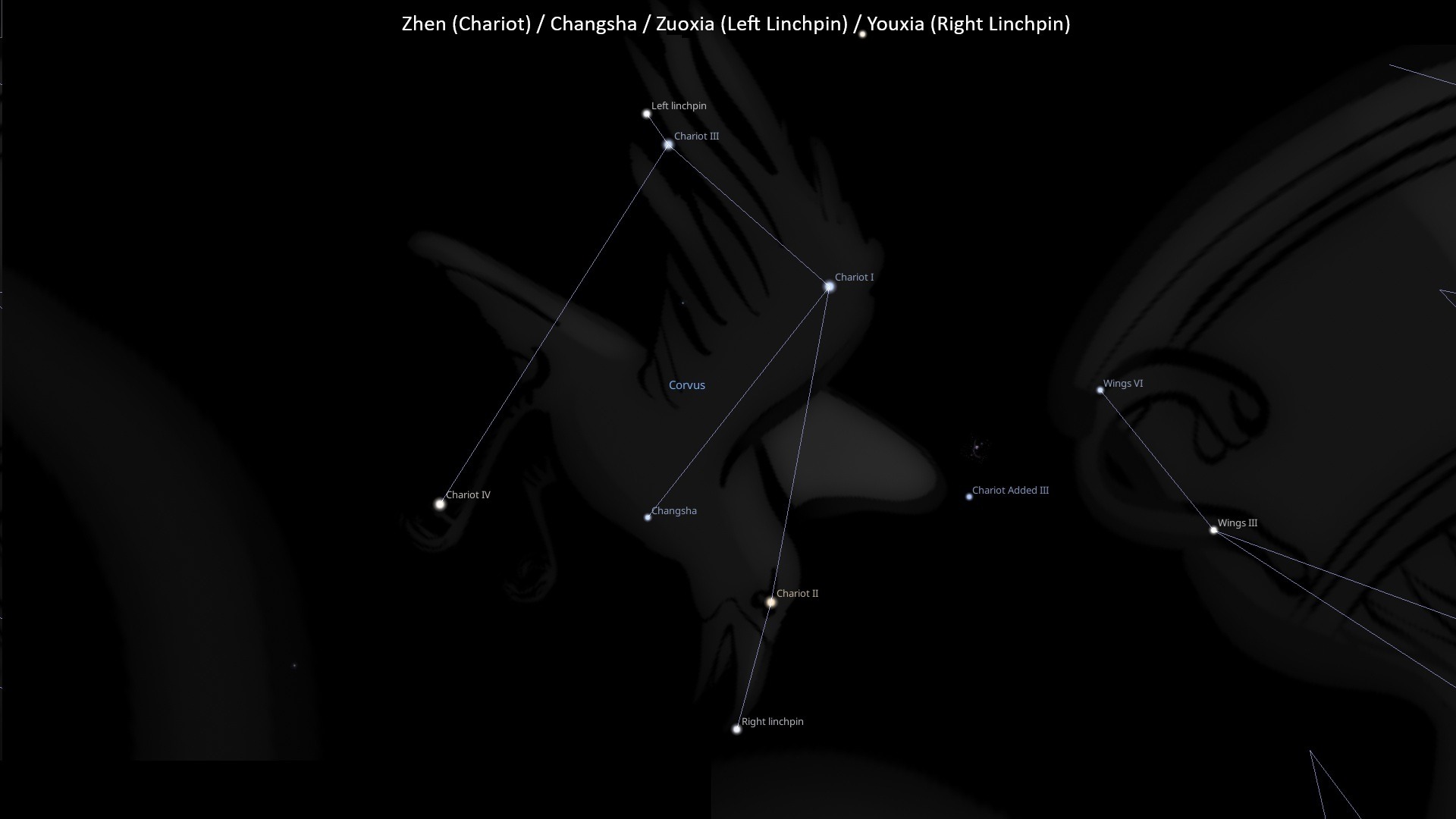
The 28th Chinese lunar mansion is 軫宿 (Zhěn Su), “Chariot Mansion.”
The 1st asterism of the Chariot Mansion is also named 轸 Zhěn, “Chariot.” It represents the tail of the Vermilion Bird, also known as the Heavenly Chariot, and contains 4 stars of the constellation Corvus.
The 2nd asterism of the Chariot Mansion is named 長沙 Chángshā, “Changsha.” It represents a place name in Hunan Province and contains 1 star of Corvus.
The 3rd asterism of the Chariot Mansion is named 左轄 Zuǒxiá, “Left Linchpin.” It represents the left nail inserted into the hole at the end of the shaft, or the axle; it can also represent a king or vassal appointed by the Yellow Emperor; the left vassal signifies the investiture of a vassal of the same surname. It contains 1 star of Corvus.
The 4th asterism of the Chariot Mansion is named 右轄 Yòuxiá, “Right Linchpin.” It represents the right nail inserted into the hole at the end of the shaft, or the axle; it can also represent a king or vassal appointed by the Yellow Emperor. The right axle signifies the investiture of a vassal of a different surname. It contains 1 star of Corvus.
Together, these first 4 asterisms form the image of a chariot. [1]
| 2000 | 2050 | IAU | Chinese | Orb |
| 10♎43 | 11♎25 | γ Crv | Zhen Su Yi | 2°10′ |
| 11♎40 | 12♎22 | ε Crv | Zhen Su Er | 1°50′ |
| 13♎27 | 14♎09 | δ Crv | Zhen Su San | 1°50′ |
| 17♎22 | 18♎04 | β Crv | Zhen Su Si | 2°10′ |
| 13♎48 | 14♎30 | ζ Crv | Changsha | 1°00′ |
| 13♎49 | 14♎31 | η Crv | Zuoxia | 1°10′ |
| 12♎15 | 12♎57 | α Crv | Youxia | 1°20′ |
Constellation Zhen the Chariot
10♎43 to 17♎22
Constellation Zhen, also known as “Tianche” (Heavenly Chariot), is the seventh mansion in the Vermilion Bird of the south. It sits at the bird’s tail, which it uses for navigation. Located southwest of Spica, the four stars of the Zhen asterism correspond to the constellation Corvus. In Greek mythology, this raven was a messenger of Zeus, possessing silvery-white wings and the ability to understand language. In ancient Babylon, it was considered the wind star. [2]
It is believed the chariot governs chariots, horses, and the wind. Another theory suggests that the character “衡” in Hengshan (Hengshan Mountain) may derive from the meaning of the Zhen constellation, which balances a carriage. [1]
“Zhen” carries connotations of sorrow; thus, the Zhen mansion is inauspicious. It can bring separation, financial ruin, constant fear and unease. Traveling to the north is considered unlucky. Suitable activities include buying farmland, enrolling in school, building, weddings, and tailoring. Wealth and honor bring longevity and prosperity; full granaries bring good fortune. A scholar’s burial brings blessings, ensuring peace and tranquility in the dwelling and preventing misfortune.
People born under the Zhen constellation are blessed throughout their lives, and their fortune increases with age. They are quick-witted, efficient, adaptable, steady, and insightful, and learn new skills quickly. With a thirst for truth and philosophical thought, they enjoy art and religion and prefer to immerse themselves in the spiritual world. They can do great things, are destined to have daughters, and are suited for immigrating abroad. Developing their careers in the south is auspicious.
However, they are impatient, introverted, timid, prone to jealousy and tend to have poorer health. Due to their low-key approach to life and penchant for keeping a low profile, they are suited to working behind the scenes or in decision-making roles where they can better use their abilities. Most people born under this sign are gentle and soft-spoken, which can make them seem quiet and delicate. However, deep down, they won’t allow others to cross their boundaries or get too close. They tend to isolate themselves in their own world. [2]
- The character 轸 (zhen) is written as 车 (che) on the lacquered box lid of the tomb of Marquis Yi of Zeng (433 BC). [3]
- The Records of the Grand Historian, Treatise on Celestial Offices (91 BC), states: “The chariot is a vehicle and governs the wind.” [1]
- The Shuowen Jiezi (100 AD) defines Zhen as “the crossbar at the back of a chariot.”
- [3]
- The Western Steps to Heaven Song (600 AD) states: “The four stars of Zhen are not of equal size, a black star hidden in the middle of Changsha.” [3]
- According to the Book of Jin, Treatise on Astronomy (648 AD), the four stars of Zhen symbolized “chariots and cavalry” and “carrying duties,” that is, war chariots and war missions. [4]
- The Suoyin commentary (745 AD) explains: “The four stars of Zhen are in the center, with two more stars forming the left and right axles, symbolizing a chariot.” [3]
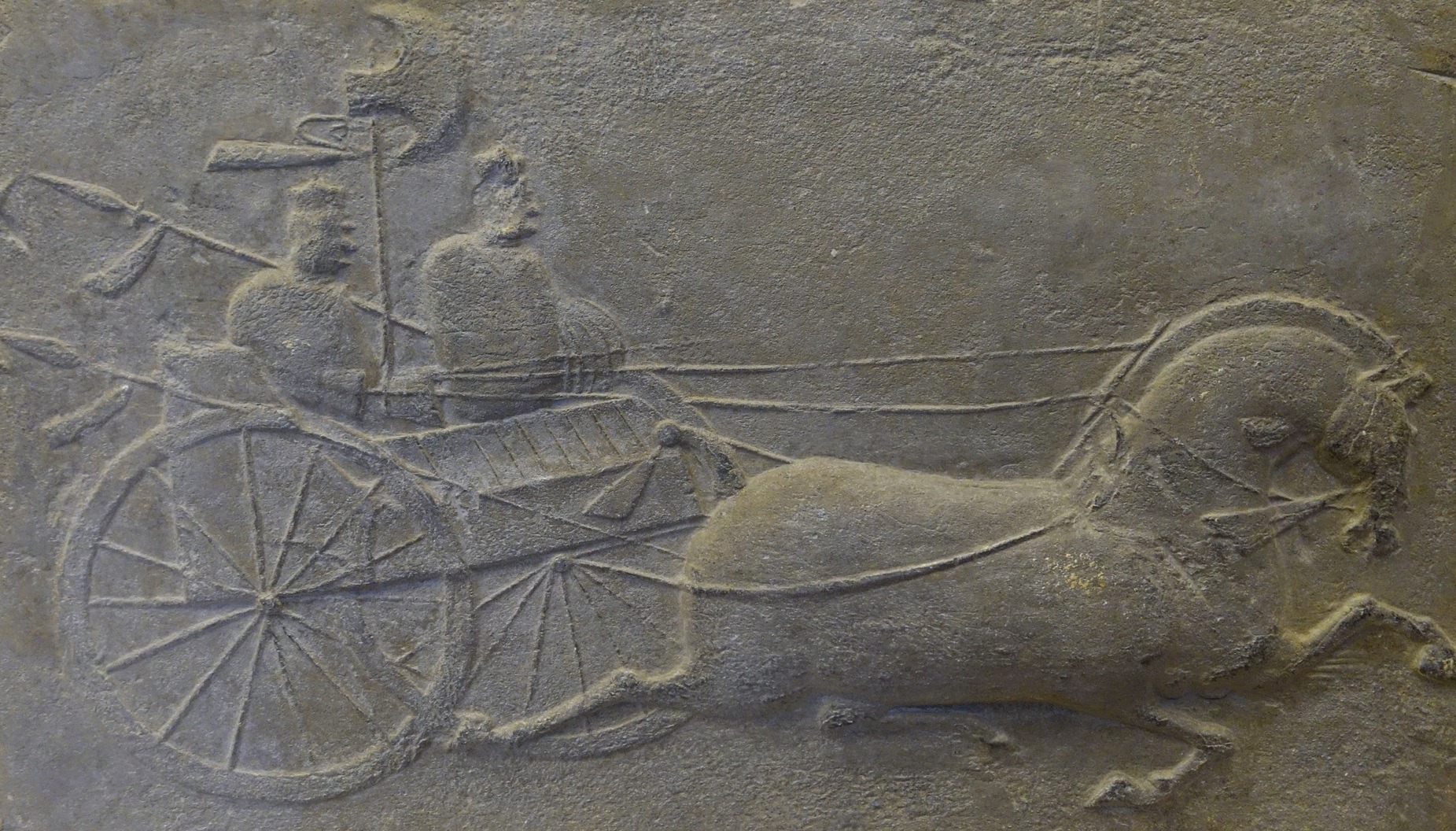
Axe chariot, Eastern Han dynasty, 25-220 AD [Wikimedia Commons]
The Zhen constellation is the celestial war chariot. Like modern tanks, it symbolized a state’s military power. Changes in the constellation foreshadowed the mobilization and outbreak of war. [4]
Ma Duanlin (1317)
The four stars of the Zhen constellation resemble the Zhang (Extended Net) and Yi (Wings) constellations, with one star at the center, Changsha, and two stars attached to its left and right.
Zhen is 17 degrees. Gan Shi (220 AD) says that the seven stars of Zhen govern matters concerning generals, the Music Bureau, and festive songs. If any of the Five Planets encroach upon it, it signifies a loss of position or the fall of a state, a woman seizing power, people losing their livelihoods, and bandit factions abducting people; calamity will strike within one hundred days. If the stars shine brightly and appear large, the world will flourish, the people will be healthy, and the realm will unite under the sovereign.
Zhang Heng (78 – 139 AD) states that Zhen represents the Grand Steward (Prime Minister) and assisting ministers, as well as governing chariots and cavalry; if the stars are bright and large, chariots and cavalry will be deployed. Another view holds that brightness and size indicate the movement of chariots and cavalry.
The Sui Shu (636 AD) notes that it governs transport and heavy loads; Zhen divines the movement of armies. It also governs death and mourning. Brightness indicates that the imperial carriage and retinue are fully prepared. Movement signifies the deployment of chariots and cavalry; if the stars scatter or shift apart, the Emperor faces anxiety; if they cluster together, a major military campaign arises.
The “Xia” (Linchpin) stars flank Zhen and govern princes and nobles; the right Xia represents the sovereign’s kinsmen, while the left represents those of different surnames. If these stars shine brightly, a major war breaks out. If they appear distant from Zhen, it is inauspicious; if the Xia stars rise or shift upward, the Southern Barbarians will invade. Zhang Heng states that if the Xia stars are invisible, the state faces great sorrow.
The single star named Changsha lies within Zhen and governs longevity; if Changsha shines brightly, people live long lives and descendants prosper. [5]
Song History (1346)
The four stars of Zhen (Chariot) asterism govern the Grand Steward, ministerial aides, chariots and cavalry, and the transport of burdens. Divinations regarding the movement of armies are conducted based on Zhen. It also governs the wind and portends death and mourning.
If the stars are large and bright, chariot forces are fully prepared; if they shift position, the Emperor worries; if they cluster together, war breaks out.
The two Xia (Linchpin) stars flank Zhen and govern princes and marquises; the left Xia represents royals of the same surname (clan), while the right Xia represents those of different surnames (clans). If these stars are bright, major warfare erupts; if they drift far from Zhen, it is ominous; if a linchpin star rises high, Southern Barbarians invade; if a chariot lacks a linchpin, the state faces trouble.
Changsha One Star lies within the Zhen Su constellation and governs longevity. If bright, the ruler enjoys a long life and descendants flourish.
A solar eclipse here signifies trouble for generals and ministers and warns officials in charge of chariots; it also signifies unease for the Empress.
A halo accompanied by “parhelia” (mock suns or “back-suns”) indicates that armies will rise, cities will fall, and victory lies in attacking the direction indicated by the mock sun; it is also considered a bad omen for the ruler.
A lunar eclipse brings trouble to the Empress and high ministers. A lunar halo signals warfare, drought, and strong winds.
If Mercury transgresses Zhen, epidemics spread, ministers face trouble, and a high-ranking figure in the Central Kingdom dies. If it remains over Zhen Su for an extended period, great floods occur. If it enters Zhen, the world will suffer fire, or a national mourning event will occur.
If Venus transgresses Zhen, war breaks out, and territory is seized. If it enters Zhen, war breaks out; if it remains over Zhen Su, land is lost, and generals face trouble. If it rises from the left horn (Spica) and moves in retrograde to Zhen Su, territory is lost. If it traverses across the sky, armies fill the fields.
If Mars transgresses Zhen, mutinous troops appear; if it enters Zhen, a general rebels, water damages crops, and superstitious rumors spread among the people; if it moves in retrograde, it portends fire and war.
When Jupiter transgresses Zhen, it brings fire, epidemics, trouble for ministers, and punishment for those in charge of the treasury (armory); if it enters Zhen, the state faces ruin; if it lingers there, the state suffers a royal death; if it remains for seven days without moving, there will be an amnesty, though the ruler may also face trouble.
If Saturn transgresses Zhen, it signals war and major earthworks; if it enters Zhen, the army will be defeated; if it moves in retrograde, the female ruler faces trouble; if it enters, exits, stations, or lingers there, war breaks out within sixty days, accompanied by severe drought.
If a “guest star” (an unexpected star or nova) transgresses Zhen, it heralds warfare and mourning; if it enters the asterism, there will be major earthworks, a rise in grain prices and the arrival of envoys from feudal lords; if it exits, the ruler will dispatch envoys to the feudal lords; if it remains over Zhen Su for an extended period, border hostilities will erupt, and the people will face famine; if it settles upon the “hub” (Changsha), military commanders will face distress.
If a comet transgresses Zhen, it signifies war and mourning; a reddish hue signifies the ruler’s moral failure, or alternatively, it indicates that the emperor raises an army or dukes are deposed.
If a 孛 “bei” star (a hairy or hazy tailless comet) appears in Zhen Su, it also signifies warfare and mourning; alternatively, it indicates subordinates plotting against superiors or the ruler has worries.
If a meteor (falling star) transgresses Zhen, it signifies war and mourning, and within a year, the treasury will be empty. If it occurs in spring or summer, it signifies leather being used for military purposes; if in autumn or winter, floods and droughts disrupt seasonal balance. [6]
References
- Zhen Su – Baidu Encyclopedia.
- Zhen (Zhen Water Earthworm).
- Twenty-Eight Mansions – Baidu Encyclopedia.
- Notes on Ancient Chinese Astronomy (8) – Swift as the Wind.
- General Examination of Literature, Volume 279, Part 2, Ma Duanlin, 1317.
- Song History, Volume 51, Chapter 4, 1346.
Saturn 17° retrograde 11th
Zhen or Algorab, add to astrology King hedgehog concept Lunar return, synastry with its inspiration open degree Street Roses
https://postimg.cc/sBM7Xgrx.
We see a hexagon, and also a few other ‘dark’ type planets and objects, the Hale Bopp comet and Orcus on lunar return ascendant. Algorab 2nd house of values, and appears to be war, a comet entering Zhen? But we see Hale Bopp square and trine this star. It’s no Kings day, but where are the protest royals in the chart? The upper level trine Moon trine Sun/Saturn/Neptune, the pyramid inverts in the artwork, where one sees Pluto in Sagittarius, half horse, half man. So be it, Ayatollah of the Artwork, but spare the comparisons with Sun, it’s peregrine in Aquarius Roses., remember we have Priapus and Lilith on its axis
Had a dream last night, one of those pre dawn visions.
Chart 6 am, and look at it in synastry with 1962 stellium, 4 February New moon.
https://postimg.cc/yD96WtNh
Add Kraz, beta Corvi, the breast of the Crow or Raven. described as representing a star in transition.
The dream was rather disturbing, a trailer that was being used as a boiler room operation. I was doing investment research, and conflicting messages, looked into the affair and discovered a promotion, which used Artwork for cover to milch its inherent value. Look around and UN, individuals, and Socialist type political parties often snooping into the mechanism of Artwork creation, and it’s been said a few times Artwork doing their job. But looting hierarchy bawls and we see no kings, but look who shows up to lead the protest. Artwork actually conservative Saturn-Jupiter and why socialists can’t handle it externally? a dream shown, the characters in the dream ‘mooning’, and I awake.
Probably should add what I see in the chart. Pisces ascendant, Neptune ruler where having and describing a dream, transformative Neptune 8th in both charts, and if using dispositors, it’s likely Artwork charts are put through the mulch mill, and don’t want to rob someone’s line to Artwork NATO invoice scheme, dispositor astrology. But Neptune we see it in dream conjunct Saturn -Sun and Eris in stellium astrology, and it makes a sextile with dream Pluto, and other planets in stellium chart. The dream one could say, activates the stellium part of fortune, and why I’m inclined to use it, a yod that culminates fortuitously ‘for someone else’.
By adding Kraz we see minor grand trine ‘wings’ and at either end stellium nodes, the chart about dream transformation, the Crow or Raven breast, and one could say it’s pituitary in its organic development.
Dominant triangle, where Jupiter-Canopus has a religious theme, trine Neptune, but triangle itself takes a challenged square to Kraz -part of fortune, and a Jupiter-Canopus quincunx to major point in 1962 stellium, finally the preferred aspect somehow, God willing, we achieve a preferred morphology, Kraz being tropical Libra, and in consideration of the D’arcy Thompson model.
We look at the D’arcy Thompson morphology model with 29 March 2026 transits, particularly Moon ingress Virgo conjunct Regulus
https://postimg.cc/TyLcZ4z2
Kraz-Seginus-Cardinal conjunct. A quick review of Pluto, and it is not South declination out-of -bounds on either date, but we see lots made of this point, 31 August 2025, and important to remember recent inverted triangle astrology vis-à-vis Pluto, South declination Pluto not out-of-bounds, and that means sorry boiler room artwork astrology invoice bawlers, you may be audited.
Is it common for men and women separation traits? Or is that cuz it’s libra?
Anyway, it’s early but I am up. They are heading to hospital. Baby woman on the way. One day after predicted due date, but she ain’t hanging in for no darn inducement tomorrow.
Not usually but it seems to be more common in Chinese astrology.
That yin and yang thing that winds thru everything I guess.
Isn’t it German language that has genderized descriptors. I could be wrong on that.
I have not really made the separation of masc and fem within.
I read the full Moon piece and there is an energy there that makes my mars rx tired. Really tired. 🤣